
Noorani Qaida Questions Answered
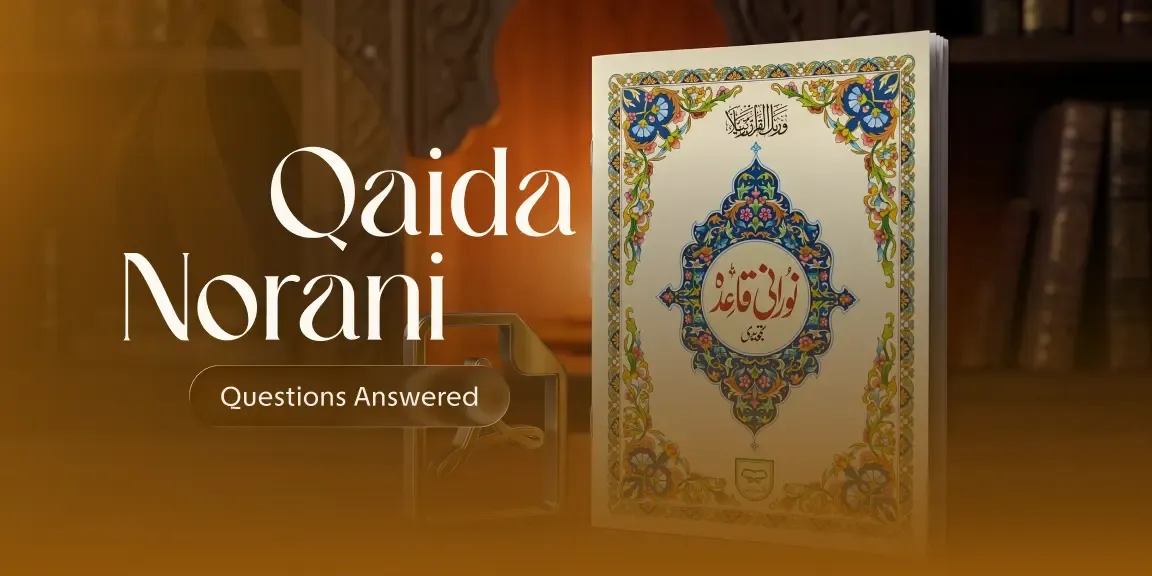
Should your child study Noorani Qaida before Tajweed? Why does one teacher count lessons differently from another? And does reaching the last page mean someone is ready to read the Quran?
These questions can make a simple starting decision confusing. This guide explains lesson order, editions, digital materials and readiness for the next stage. It also covers adult beginners and choosing between a printed book and a screen, so you can begin with clear expectations.
Is It Better to Learn Tajweed or Noorani Qaida First?
Begin with Noorani Qaida if you cannot yet recognise Arabic letters and read basic combinations, while practising correct pronunciation from the first lesson.
Noorani Qaida builds the reading foundations that make more detailed Tajweed instructions easier to follow. A beginner first needs to identify what is written before applying increasingly complex recitation rules to it.
However, this does not mean pronunciation should wait until the Qaida is finished. Letter sounds, articulation and the correct application of marks belong within early reading instruction. The distinction is between practising these foundations and studying Tajweed in greater depth.
Your current reading ability | Suitable starting discussion with a teacher |
You cannot recognise Arabic letters | Begin with alphabet recognition and sounds |
You recognise letters but struggle with combinations | Assess the relevant Qaida exercises |
You read words but make repeated pronunciation errors | Check which foundations need revision alongside Tajweed |
You read accurately and want to refine recitation | Discuss a suitable Tajweed level |
If you already read Arabic, ask for an assessment rather than automatically restarting. A teacher can decide whether focused revision or a Tajweed course better matches your needs.
How Many Lessons Are in Noorani Qaida?
Al Asr Quran Academy currently describes its Noorani Qaida course as a 16-lesson sequence; that count should not be treated as a universal description of every edition.
A lesson count becomes useful only when you know what the publisher or teacher is counting. A printed section, a practice page and a live teaching session are different things.
For example, a teacher may spend several classes on one section because the learner needs additional practice. Another section may be understood quickly. Sixteen lessons in a course outline therefore does not mean sixteen appointments.
What Should You Compare Between Editions?
Compare the contents and exercises, not just the final lesson number.
Check whether your book and teaching materials introduce corresponding concepts in a compatible sequence. Look at how they present letter recognition, joined forms, vowel marks and later reading combinations.
Before buying a copy, ask:
- Which edition does the teacher use?
- Do its page numbers match the lesson materials?
- Are revision exercises counted as separate lessons?
- Does the course add activities beyond the printed book?
- Which skills must be secure before moving forward?
These questions are especially helpful if a child studies with a teacher while a parent follows a different copy at home.
Does a Higher Lesson Number Mean Better Progress?
A higher lesson number shows where the learner is working, but does not establish how independently they read.
A student may recognise familiar examples through repetition yet hesitate when the same letters appear in a different combination. Another may progress slowly through the pages while developing stronger independent reading.
Ask what the learner can now do without prompting. That gives a clearer picture than comparing page numbers with another student.
What Does “Noorani Qaida” Mean?
“Noorani Qaida” is the name commonly used for a beginner primer that teaches the foundations of reading Arabic for Quran recitation.
In this educational context, Qaida refers to foundational instruction or a primer. The practical meaning for a learner is a starting book that introduces reading skills in manageable stages.
You may encounter spellings such as Noorani Qaida, Norani Qaida or Qaida Noorani. English spelling alone does not establish whether two resources use the same edition, layout or exercises.
The resource is primarily concerned with reading. It should not be confused with a Quran translation, a complete Arabic language course or a memorisation programme.
Learning goal | What it involves |
Recognising Arabic script | Identifying letters, forms and marks |
Reading aloud | Connecting the written text with its sounds |
Understanding meanings | Studying vocabulary, translation and explanation |
Memorising passages | Retaining and recalling previously studied text |
These goals can support one another, but success in one does not automatically establish success in all of them.
A learner may recite a familiar surah from memory without recognising every written word. Another may read an Arabic passage aloud while needing help with its meaning. Knowing which skill you want to develop makes course selection easier.
Is There a PDF Version of Noorani Qaida for Kids?

Yes, digital Noorani Qaida editions suitable for children are available, but download and printing permissions must be checked for the particular edition.
A file appearing in search results does not establish that its uploader has permission to distribute it. Use a publisher or another authorised source, and check whether personal printing or sharing is permitted.
This article does not offer or link to a downloadable Qaida edition.
For a child, readability matters as much as convenience. Open a sample page on the actual device the child will use. Letters and vowel marks should remain clear without constant scrolling or awkward zooming.
What Makes a Digital Copy Practical for a Child?
Look for:
- Clear Arabic text with visible dots and marks.
- Complete pages in the correct order.
- A layout matching the teacher’s copy.
- Simple page navigation.
- Enough screen space to follow the exercise comfortably.
Some children find it easier to point along a printed line. Others use a tablet comfortably with adult support. Choose according to the child’s actual reading behaviour.
A PDF displays the exercise but does not assess pronunciation. Audio can demonstrate a sound, while a competent listener can check the child’s attempt.
If a resource includes English transliteration, occasionally cover it and check whether the child can read the Arabic independently.
How Do I Know I Have Finished the Qaida?
You are ready to move beyond the Qaida when you can apply its reading skills independently and a teacher confirms that the next stage is appropriate.
Reaching the last page is one part of completing the material. Demonstrating the skills without relying on a memorised sequence is the more useful assessment.
The following checks can guide a discussion with your teacher. They are practical assessment suggestions, not a published Al Asr examination rubric.
Skill to check | What an assessment can include | What may need further practice |
Letter recognition | Selecting letters in a different order | Identifying them only in a familiar sequence |
Joined forms | Reading letters within combinations | Recognising isolated forms but guessing joined ones |
Vowel marks | Reading examples with different marks | Naming letters while overlooking their marks |
Pronunciation | Producing sounds after the model is removed | Depending on continuous imitation |
Combining skills | Reading unfamiliar examples using taught concepts | Reading only previously memorised lines |
Independent reading | Attempting an exercise before receiving help | Waiting for someone to supply each sound |
What Can Parents Check at Home?
Ask the child to read a small selection from earlier exercises without playing the recording first. Point to examples in a different order and allow time for an independent attempt.
Note where the child hesitates. Avoid repeatedly supplying the answer, because that makes it difficult to see what they recognise.
If you are unsure about pronunciation yourself, share the uncertainty with the teacher. You can observe independence and attention without claiming to assess every Arabic sound.
What Happens if Some Skills Are Still Uncertain?
Ask for focused revision. Difficulty with one concept does not necessarily require repeating the entire book.
For instance, a learner may recognise letters securely but need more practice applying marks within combinations. The next task should address that difficulty directly.
After foundational skills are secure, the teacher can introduce supported Quran reading and continue correcting pronunciation. Progressing beyond the Qaida does not mean correction or revision has ended.
Can Adults Start Noorani Qaida From Zero?
Yes, adults can start Noorani Qaida without previous Arabic reading knowledge.
The starting lesson should depend on current ability. Being an adult does not mean you must already recognise the alphabet, and remembering childhood lessons does not mean you need to repeat every page.
Tell the teacher what you can do comfortably. You might recognise some letters, recite from memory, follow transliteration or have no previous experience at all.
A useful first assessment separates these abilities. It checks what you can read rather than assuming that familiar recitation proves script recognition.
What if You Feel Embarrassed?
You can request individual instruction and explain that you want a patient introduction to the basics. There is no need to justify why you are beginning now.
Before enrolling, discuss your preferred teaching language, available practice time and comfort with reading aloud. A suitable lesson should make it possible to ask for another demonstration without feeling rushed.
Al Asr’s Noorani Qaida online course includes adult beginners and offers one-to-one instruction. An initial assessment can establish whether you need a complete introduction or targeted revision.
Will Adults Finish Faster Than Children?
Not necessarily. Previous knowledge, consistency, pronunciation needs and available attention all affect progress.
Avoid choosing a deadline solely because another learner finished quickly. Ask the teacher which skills need attention and how your practice can support them.
Do I Need the Physical Noorani Qaida Book?
No, a physical book is not essential when you have a readable, authorised digital copy that works with your lessons.
The better format is the one you can follow comfortably while listening, reading aloud and receiving corrections.
Practical consideration | Printed book | Digital copy |
Following a line | Easy to point directly at the page | Depends on screen size and navigation |
Enlarging text | Requires a suitable print size | Usually allows zooming |
Using one device for class | Leaves the screen available for the teacher | May require switching windows |
Keeping materials available | Needs to be carried with you | Can be stored on a compatible device |
Matching the lesson | Edition and page references must match | Edition and page references must match |
If you attend a video lesson on a phone, opening a PDF on that same phone may make the page difficult to follow. A printed copy or a separate screen can help.
Before purchasing materials, ask the teacher for the edition details. This avoids arriving with a book whose exercises or numbering differ from the class.
Whichever format you choose, keep your place marked and bring one clear question to the next lesson. The book provides the exercises like regular practice and specific feedback to help turn them into reading skills.
Ready to start learning the Quran?
Book a free trial class with a certified tutor — no credit card, no commitment.
Book Your Free Trial