
Madd and Leen Letters: Lengthening Sounds in Quranic Arabic
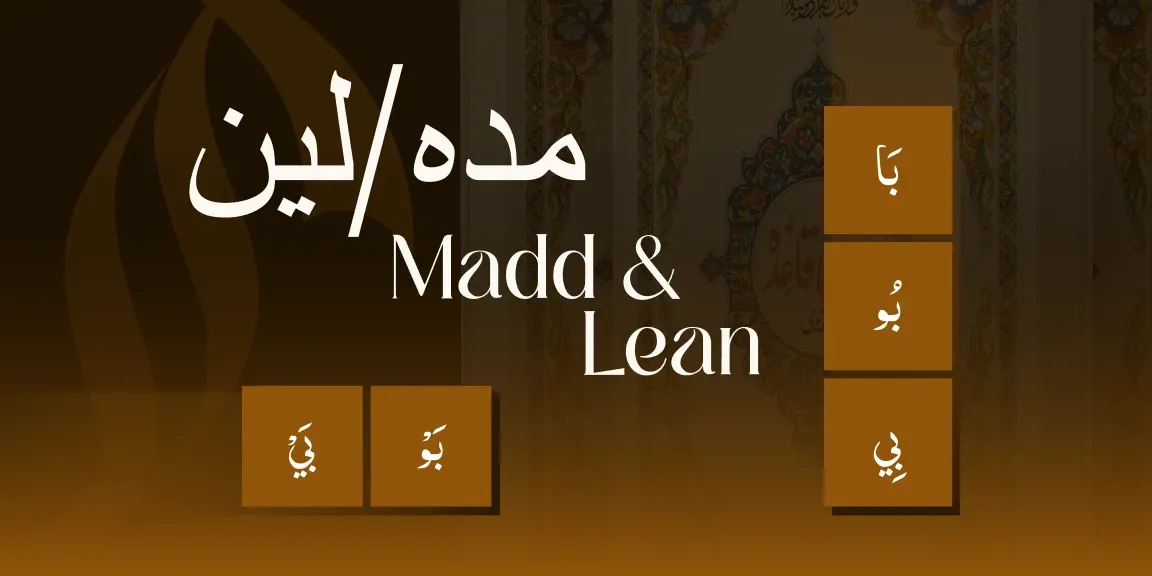
Does a wāw always make an “oo” sound? Why does yāʾ sound different in two familiar Quranic words? The answer often lies in the vowel before the letter. Confusing Madd and Leen can turn a soft sound into a long vowel or make a reader stretch the wrong part of a word. This guide explains their letters, pronunciation, basic timing, and stopping rules, with short Arabic exercises for practice at home.
What Are Madd and Leen in Quranic Arabic?
Madd means lengthening a sound. Its three letters are alif, wāw, and yāʾ when they meet the appropriate vowel conditions. Leen means softness and involves wāw or yāʾ with sukoon after a fatḥah.
A Leen letter and the stopping rule called Madd al-Leen are related but distinct. Recognising the letter comes first; deciding whether to lengthen it requires checking what follows and whether you are stopping.
This beginner guide follows commonly taught Ḥafṣ ʿan ʿĀṣim recitation. A teacher should guide the detailed timing and permitted combinations within the recitation pathway being studied.
Which Letters Form Madd and Leen?

Look at the preceding vowel as well as the letter itself.
Type | Letter and condition | Practice form | Sound guide |
Madd | Alif after fatḥah | بَا | bā: a long “aa” |
Madd | Sākin wāw after ḍammah | بُو | bū: a long “oo” |
Madd | Sākin yāʾ after kasrah | بِي | bī: a long “ee” |
Leen | Sākin wāw after fatḥah | بَوْ | baw: a soft “aw” |
Leen | Sākin yāʾ after fatḥah | بَيْ | bay: a soft “ay” |
These are sound exercises, not a list of Quranic words. Transliteration is only a reminder of a sound that should be heard from a teacher.
Wāw and yāʾ can also act as ordinary consonants. Their presence alone does not establish Madd or Leen. Likewise, do not rely solely on finding a printed sukoon: marking conventions differ between learning books and Quran editions.
How Should Madd and Leen Sound?

For the practice forms above, keep the difference audible:
- بُو / بَوْ: sustain the long vowel in bū; let baw move smoothly into its wāw sound.
- بِي / بَيْ: sustain the long vowel in bī; let bay move smoothly into its yāʾ sound.
- بَ / بَا: distinguish a short fatḥah from a long ā.
Avoid turning baw into bū or bay into bī. English accent habits can blur these distinctions, so listening and correction matter more than memorising an English spelling.
Hold the sound evenly rather than adding a separate syllable. A stretched vowel should remain connected to the word, with no extra hamzah inserted midway.
What Are the Basic Madd and Leen Rules?
Natural Madd, or Madd Ṭabīʿī, lasts two vowel counts. A count follows the recitation’s pace; it is not a fixed second. Other Madd categories have additional causes and rules, so two counts should not be applied to every long vowel without checking its context.
In ordinary continuation, preserve the soft Leen sound without automatically applying a two-, four-, or six-count stopping stretch. When a Leen letter immediately precedes the word’s final consonant and that consonant becomes sākin through stopping, Madd al-Leen can permit two, four, or six counts. These choices have consistency requirements alongside other stopping lengthenings; follow the pattern your teacher assigns.
For example, the sound in خَوْف is khawf, not khūf. When stopping on this word, its structure supports Madd al-Leen. During connected reading, its pronunciation must fit the surrounding text and applicable rules.
At this stage, use three questions before reading:
- What vowel comes before the wāw or yāʾ?
- Is the letter functioning as Madd, Leen, or a consonant?
- Am I continuing or stopping here?
Madd and Leen Examples for Practice
Begin with short patterns, then identify the same features in Quranic words.
Exercise | Focus |
بَ — بَا | Short fatḥah compared with long ā |
بُ — بُو | Short ḍammah compared with long ū |
بِ — بِي | Short kasrah compared with long ī |
بُو — بَوْ | Madd wāw compared with Leen wāw |
بِي — بَيْ | Madd yāʾ compared with Leen yāʾ |
Read one row at a time. Identify the vowel, listen to a model, and repeat. Keep the letter sound steady while changing only the feature being practised.
The following words appear in Surah Quraysh. The table isolates the relevant feature; it does not replace reading each word in its full verse.
Location | Feature to identify |
106:1 | Sākin yāʾ after fatḥah: Leen |
106:3 | Sākin yāʾ after fatḥah: Leen |
106:4 | Wāw after ḍammah: Madd |
106:4 | Sākin wāw after fatḥah: Leen |
Ask a teacher to demonstrate جُوعٍ and خَوْفٍ in the verse, then demonstrate stopping on each separately. This makes the difference between the underlying sounds easier to hear. Use isolated stops as a supervised exercise; verse meaning and stopping guidance also matter in recitation.
For children who still struggle to recognise Arabic letters and vowels, broader reading practice can complement Qaida lessons. The Dubai Government Media Office’s announcement of Arabic lessons on Madrasa describes material covering reading, speech, grammar, and writing. Such language practice supports foundational literacy, while Quranic timing still needs recitation instruction.
Common Madd and Leen Mistakes
Mistake to watch for | A useful correction |
Calling every wāw a Madd letter | Check the vowel before it and whether it carries a vowel itself. |
Reading بَوْ like بُو | Compare the two forms immediately after a teacher’s model. |
Reading بَيْ like بِي | Notice the fatḥah before Leen yāʾ instead of expecting kasrah. |
Stretching a short vowel unintentionally | Alternate a short form and its long counterpart slowly. |
Holding every Leen letter for six counts | Establish continuation or stopping before deciding timing. |
Treating two counts as two seconds | Match the teacher’s pace and keep relative lengths consistent. |
Correct one feature at a time. If a learner confuses the written patterns, return to recognition before increasing reading speed. If recognition is secure but pronunciation remains unclear, practise a small contrast rather than repeating a whole page without feedback.
Parents can point to the preceding vowel and ask the child to name it. Avoid judging progress only by speed: identifying why a sound changes is a useful part of the lesson.
Where Do Madd and Leen Fit in Noorani Qaida?
Students need a working understanding of short vowels and sākin letters to interpret these patterns. The order and numbering of lessons vary between Qaida editions and teaching programmes.
Al Asr Quran Academy’s published Noorani Qaida course outline lists “Long Vowels & Soft Letters (Madd and Leen)” as its eighth topic. This refers to the academy’s outline, not a universal page or lesson number in every printed Qaida.
A practical progression is to recognise the patterns, distinguish them aloud, and then read them within words. Detailed stopping lengthenings can be introduced with teacher guidance once those foundations are reliable.
How Can a Tutor Check Madd and Leen Pronunciation?
A focused assessment can ask a learner to identify the vowel before each target letter, read contrasting forms, and explain which sound is long or soft. The teacher can then hear the same feature in a short Quranic passage, including an appropriate stop.
This helps separate a recognition difficulty from a timing or pronunciation difficulty. The next practice task should address the specific issue heard during that assessment.
For online support, Al Asr Quran Academy’s Tajweed course provides a route into further recitation study. You can also to discuss your current level and the pronunciation skills that need attention.
Frequently asked questions
How many Madd letters are there?
There are three: alif, wāw, and yāʾ. Each functions as a Madd letter under its particular vowel conditions; simply seeing the letter is not enough.
How many Leen letters are there?
There are two: wāw and yāʾ with sukoon when preceded by fatḥah. Alif is not one of the two letters of Leen in this classification.
What is the main difference between Madd and Leen?
Madd produces a long vowel under the relevant conditions. Leen produces a soft aw or ay sound. Wāw and yāʾ can belong to either category depending on the vowel before them.
Is Leen always stretched for two counts?
No. Do not apply a stopping length to every Leen letter in connected reading. First identify whether the conditions for Madd al-Leen at a stop are present.
Can a child practise Madd and Leen at home?
Yes. Use a few teacher-assigned examples and repeat a clear audio model. Keep practice focused on accurate sounds, and bring uncertain pronunciation back to the teacher for correction.
Should beginners memorise every Madd category immediately?
Start with recognising long vowels and soft letters accurately. Add the wider Madd categories and their conditions in the order your teacher sets, with spoken examples alongside each rule.
Ready to start learning the Quran?
Book a free trial class with a certified tutor — no credit card, no commitment.
Book Your Free Trial