
Noorani Qaida Lessons: The Complete Lesson-by-Lesson Guide
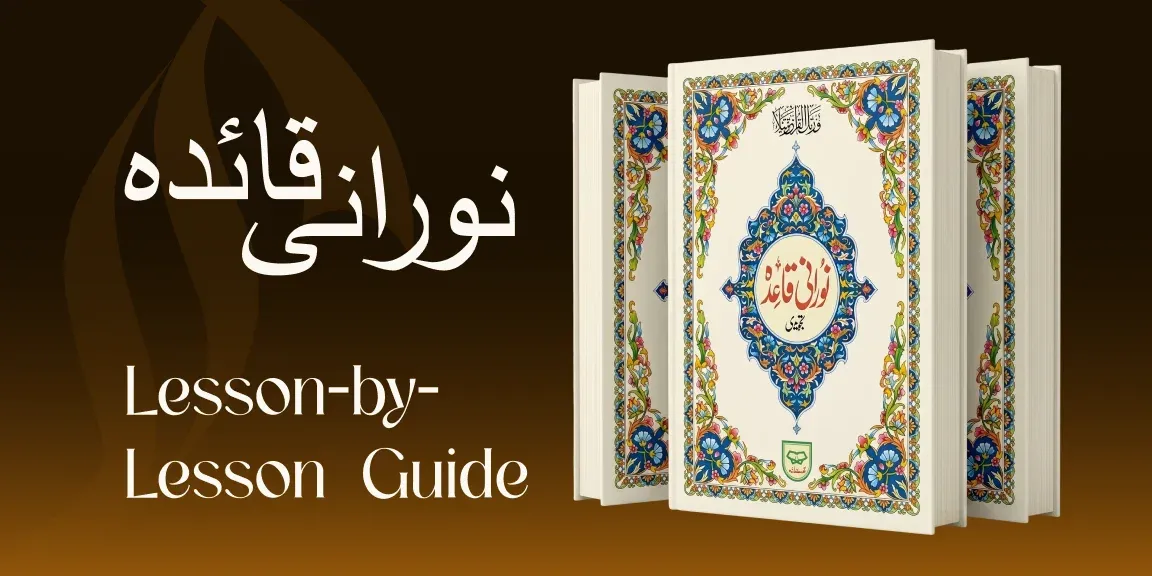
Finishing a Qaida page feels encouraging. Opening the next one and struggling with familiar letters can feel frustrating. Progress becomes clearer when you know what each lesson is meant to develop. This guide walks through Al Asr Quran Academy’s Noorani Qaida lesson sequence, explains practical checks for each stage, and shows how to judge readiness for Quran reading beyond simply reaching the final page.
How Are Noorani Qaida Lessons Structured?
Noorani Qaida lessons build Arabic reading skills through letters, vowel marks, sound combinations, and guided recitation. A lesson introduces a feature, provides practice, and prepares the reader to combine it with earlier skills.
Al Asr Quran Academy has 16 teaching topics. The walkthrough below follows that outline. It is not a claim that every printed Noorani Qaida edition has the same sixteen numbered lessons, examples, or page layout.
A lesson identifies a teaching unit. A page identifies its location in a particular book. The word takhti may be used for a lesson or practice chart, depending on the teaching tradition. Before following a lesson video, compare its heading and examples with your own copy.
Noorani Qaida Lessons in Order: What Each Stage Develops

The numbered headings below identify the academy’s course topics. The suggested exercises illustrate how those topics can be practised, they are not an official examination rubric or a fixed script for every student.
1. Arabic Alphabet: Recognising Individual Letters
Objective: Identify individual Arabic letters and connect their written shapes with the sounds demonstrated by a teacher.
Start with a small group of letters. Point to each one, name it, and compare it with a similar shape. Pay attention to dots as well as the main outline. Then read the same group in a different order.
Mistake to watch for: Reciting the alphabet confidently but being unable to identify a letter outside its usual position. Remembering the sequence can hide a recognition gap.
2. Connected Letters: Recognising Shapes Within Groups
Objective: Recognise letters when they appear in joined forms, not only as separate symbols.
Compare an isolated letter with its shape in a short printed group. Find the dots, trace the reading direction, and identify where one letter ends and the next begins. A teacher can also explain why some letters do not connect to the following letter.
Mistake to watch for: Treating a joined shape as a completely new letter, or assuming that a break in the joined writing always marks a new word.
3. Disjoined Letters: Recognising Special Letter Groups
Objective: Become familiar with the special letter groups found at the beginnings of certain surahs and distinguish them from ordinary word reading.
These are commonly called Huroof Muqatta’at. Begin with recognition and teacher demonstration. Their complete recitation includes details that may need revisiting as the learner studies lengthening and other Tajweed rules.
Mistake to watch for: Trying to pronounce a special letter group as though it were an ordinary connected word.
4. Harakaat: Reading Short Vowel Marks
Objective: Distinguish fatḥah, kasrah, and ḍammah and apply them to the letter being read.
Use a simple contrast such as بَ — بِ — بُ. Keep the consonant the same while changing the vowel. Then repeat the task with another familiar letter so that the learner must interpret the mark rather than memorise one row.
The Harakaat guide provides a closer explanation of these three short vowels.
Mistake to watch for: Naming the mark correctly but reading every example with the same vowel, or stretching a short vowel unnecessarily.
5. Tanween: Recognising Double Vowel Marks
Objective: Identify the three Tanween forms and distinguish their basic connected-reading sounds from single short vowels.
Compare a single vowel mark with its doubled form. Practise teacher-selected examples first, then notice Tanween at word endings. Connected reading and stopping need separate attention because the ending is not always pronounced the same way in both situations.
The Tanween guide explains the marks and the importance of their reading context.
Mistake to watch for: Treating the doubled sign as an instruction to hold the vowel twice as long.
6. Standing Vowels: Recognising Additional Printed Signs
Objective: Recognise the standing vowel signs used in the learner’s edition and connect them with the appropriate long vowel sounds.
Some books use the familiar teaching names Khari Zabar, Khari Zer, and Khari Pesh. Their visual appearance needs to be studied in the actual text used for lessons, since Quran printing conventions are not identical across editions.
Mistake to watch for: Assuming that a small or unfamiliar sign can be ignored, or reading a standing vowel exactly like the corresponding short vowel.
7. Makharij: Produing Letters Clearly
Objective: Improve the cplace of articulation used to produce each letter, including distinctions that may be unfamiliar to an English-speaking learner.
A dedicated Makharij topic gives time for closer correction, but articulation should already be part of earlier lessons. Practise a small contrast chosen for the learner’s needs. Hearing the teacher and receiving feedback is more useful than repeatedly guessing from an English spelling.
The Makharij guide introduces the main articulation areas.
Mistake to watch for: Assuming that two letters are pronounced alike because their English transliterations look similar.
8. Madd and Leen: Separating Long Vowels and Soft Sounds
Objective: Distinguish long vowels from the soft sounds formed by wāw or yāʾ under their relevant vowel conditions.
Compare بُو / بَوْ and بِي / بَيْ using a teacher’s model. These are practice forms. The vowel before the target letter helps determine how it functions. Detailed stopping lengthenings should be taught with their conditions rather than applied to every example.
The Madd and Leen guide develops this comparison.
Mistake to watch for: Turning every wāw into a long “oo” or every yāʾ into a long “ee.”
9. Sukoon: Reading a Consonant Without an Added Vowel
Objective: Read a sākin consonant without attaching an extra fatḥah, kasrah, or ḍammah to it.
Sukoon, also called Jazm in many Qaida lessons, does not generally mean that the consonant disappears. Use short combinations, listen carefully to their endings, and connect the preceding sound to the sākin letter.
The Sukoon guide explains how this affects reading.
Mistake to watch for: Adding an extra “a” after a consonant because stopping the syllable feels unfamiliar.
10. Shaddah: Recognising a Doubled Consonant
Objective: Recognise Shaddah, also called Tashdeed, and preserve the doubled consonant in reading.
Begin by noticing the mark and listening to the teacher’s demonstration. Compare a suitable doubled form with a single-consonant form. The sound treatment depends on the letter; “make everything louder” is not an adequate explanation of Shaddah.
The Shaddah guide covers the mark in more detail.
Mistake to watch for: Ignoring the doubling, separating the consonant into two unrelated syllabFinishing a Qaida page feels encouraging. Opening the next one and struggling with familiar letters can feel frustrating. Progress becomes clearer when you know what each lesson is meant to develop. This guide walks through Al Asr Quran Academy’s Noorani Qaida lesson sequence, explains practical checks for each stage, and shows how to judge readiness for Quran reading beyond simply reaching the final page.
How Are Noorani Qaida Lessons Structured?
Noorani Qaida lessons build Arabic reading skills through letters, vowel marks, sound combinations, and guided recitation. A lesson introduces a feature, provides practice, and prepares the reader to combine it with earlier skills.
Al Asr Quran Academy has 16 teaching topics. The walkthrough below follows that outline. It is not a claim that every printed Noorani Qaida edition has the same sixteen numbered lessons, examples, or page layout.
A lesson identifies a teaching unit. A page identifies its location in a particular book. The word takhti may be used for a lesson or practice chart, depending on the teaching tradition. Before following a lesson video, compare its heading and examples with your own copy.
Noorani Qaida Lessons in Order: What Each Stage Develops
The numbered headings below identify the academy’s course topics. The suggested exercises illustrate how those topics can be practised, they are not an official examination rubric or a fixed script for every student.
1. Arabic Alphabet: Recognising Individual Letters
Objective: Identify individual Arabic letters and connect their written shapes with the sounds demonstrated by a teacher.
Start with a small group of letters. Point to each one, name it, and compare it with a similar shape. Pay attention to dots as well as the main outline. Then read the same group in a different order.
Mistake to watch for: Reciting the alphabet confidently but being unable to identify a letter outside its usual position. Remembering the sequence can hide a recognition gap.
2. Connected Letters: Recognising Shapes Within Groups
Objective: Recognise letters when they appear in joined forms, not only as separate symbols.
Compare an isolated letter with its shape in a short printed group. Find the dots, trace the reading direction, and identify where one letter ends and the next begins. A teacher can also explain why some letters do not connect to the following letter.
Mistake to watch for: Treating a joined shape as a completely new letter, or assuming that a break in the joined writing always marks a new word.
3. Disjoined Letters: Recognising Special Letter Groups
Objective: Become familiar with the special letter groups found at the beginnings of certain surahs and distinguish them from ordinary word reading.
These are commonly called Huroof Muqatta’at. Begin with recognition and teacher demonstration. Their complete recitation includes details that may need revisiting as the learner studies lengthening and other Tajweed rules.
Mistake to watch for: Trying to pronounce a special letter group as though it were an ordinary connected word.
4. Harakaat: Reading Short Vowel Marks
Objective: Distinguish fatḥah, kasrah, and ḍammah and apply them to the letter being read.
Use a simple contrast such as بَ — بِ — بُ. Keep the consonant the same while changing the vowel. Then repeat the task with another familiar letter so that the learner must interpret the mark rather than memorise one row.
The Harakaat guide provides a closer explanation of these three short vowels.
Mistake to watch for: Naming the mark correctly but reading every example with the same vowel, or stretching a short vowel unnecessarily.
5. Tanween: Recognising Double Vowel Marks
Objective: Identify the three Tanween forms and distinguish their basic connected-reading sounds from single short vowels.
Compare a single vowel mark with its doubled form. Practise teacher-selected examples first, then notice Tanween at word endings. Connected reading and stopping need separate attention because the ending is not always pronounced the same way in both situations.
The Tanween guide explains the marks and the importance of their reading context.
Mistake to watch for: Treating the doubled sign as an instruction to hold the vowel twice as long.
6. Standing Vowels: Recognising Additional Printed Signs
Objective: Recognise the standing vowel signs used in the learner’s edition and connect them with the appropriate long vowel sounds.
Some books use the familiar teaching names Khari Zabar, Khari Zer, and Khari Pesh. Their visual appearance needs to be studied in the actual text used for lessons, since Quran printing conventions are not identical across editions.
Mistake to watch for: Assuming that a small or unfamiliar sign can be ignored, or reading a standing vowel exactly like the corresponding short vowel.
7. Makharij: Producing Letters Clearly
Objective: Improve the place of articulation used to produce each letter, including distinctions that may be unfamiliar to an English-speaking learner.
A dedicated Makharij topic gives time for closer correction, but articulation should already be part of earlier lessons. Practise a small contrast chosen for the learner’s needs. Hearing the teacher and receiving feedback is more useful than repeatedly guessing from an English spelling.
The Makharij guide introduces the main articulation areas.
Mistake to watch for: Assuming that two letters are pronounced alike because their English transliterations look similar.
8. Madd and Leen: Separating Long Vowels and Soft Sounds
Objective: Distinguish long vowels from the soft sounds formed by wāw or yāʾ under their relevant vowel conditions.
Compare بُو / بَوْ and بِي / بَيْ using a teacher’s model. These are practice forms. The vowel before the target letter helps determine how it functions. Detailed stopping lengthenings should be taught with their conditions rather than applied to every example.
The Madd and Leen guide develops this comparison.
Mistake to watch for: Turning every wāw into a long “oo” or every yāʾ into a long “ee.”
9. Sukoon: Reading a Consonant Without an Added Vowel
Objective: Read a sākin consonant without attaching an extra fatḥah, kasrah, or ḍammah to it.
Sukoon, also called Jazm in many Qaida lessons, does not generally mean that the consonant disappears. Use short combinations, listen carefully to their endings, and connect the preceding sound to the sākin letter.
The Sukoon guide explains how this affects reading.
Mistake to watch for: Adding an extra “a” after a consonant because stopping the syllable feels unfamiliar.
10. Shaddah: Recognising a Doubled Consonant
Objective: Recognise Shaddah, also called Tashdeed, and preserve the doubled consonant in reading.
Begin by noticing the mark and listening to the teacher’s demonstration. Compare a suitable doubled form with a single-consonant form. The sound treatment depends on the letter; “make everything louder” is not an adequate explanation of Shaddah.
The Shaddah guide covers the mark in more detail.
Mistake to watch for: Ignoring the doubling, separating the consonant into two unrelated syllables, or replacing doubling with extra volume.
11. Waqf: Stopping and Resuming Appropriately
Objective: Begin recognising stopping signs and understand that a pause affects both pronunciation and the continuity of meaning.
Use the stopping-sign key supplied with the learner’s mushaf. A teacher should demonstrate an appropriate place to pause and a suitable place to resume. Stopping practice also revisits word endings already encountered in earlier lessons.
Mistake to watch for: Treating every printed sign as identical or restarting wherever the eyes happen to land after taking a breath.
12. Noon Sakinah and Tanween: Reading Across Letter Boundaries
Objective: Begin applying the relevant pronunciation rule when noon sakinah or Tanween is followed by another letter.
The main categories introduced here include Izhar, Idgham, Iqlab, and Ikhfa. Start with one category and clear examples. Reading involves looking ahead, not only identifying the symbol directly under the finger.
Mistake to watch for: Naming a rule from memory while giving every example the same sound.
13. Meem Sakinah: Checking the Following Letter
Objective: Recognise meem with sukoon and apply its reading treatment according to the next letter.
Practise examples selected to distinguish the relevant categories. The learner should first locate meem sakinah, then look ahead before reading. Similar terminology from other lessons should not replace listening to the actual sound required here.
Mistake to watch for: Applying a noon-sakinah rule automatically because both lessons involve a letter with sukoon.
14. Qalqalah and Ghunnah: Distinguishing Two Sound Features
Objective: Recognise that Qalqalah and Ghunnah describe different recitation features and apply each where required.
Qalqalah concerns a particular articulation effect in its designated letters under the relevant conditions. Ghunnah concerns nasal resonance. Teaching them within one course topic does not make them interchangeable.
The Qalqalah guide introduces its five letters and pronunciation points.
Mistake to watch for: Adding a full vowel to create a “bounce,” or assuming that nasal resonance belongs in every held sound.
15. Laam and Raa: Applying Heavy and Light Pronunciation
Objective: Recognise the relevant conditions for heavy and light pronunciation in the examples being studied.
A teacher should explain the specific context, including the special treatment of the lām in the name of Allah and the conditions affecting rāʾ. Avoid reducing the topic to “these letters are always heavy.”
Mistake to watch for: Carrying one familiar pronunciation into every new word without checking the surrounding vowels and other conditions.
16. Quranic Verses: Combining the Skills
Objective: Read a short Quranic passage by applying the written letters, marks, and rules together.
Choose material suited to the learner’s level. Read slowly enough to notice each feature. A familiar memorised surah can build confidence, but it should not be the only evidence that someone can decode Arabic script.
Mistake to watch for: Reciting from memory while losing the place in the text, or reading individual exercises accurately but overlooking the same features in a verse.
Why Should Foundational Skills Be Learned in Sequence?
Each new feature adds to what the reader must notice. A learner who cannot reliably identify letters will struggle to apply vowel marks to them. Someone who still adds vowels to sākin letters may find later combinations harder to manage.
The important sequence is the sequence of skills, not rigid loyalty to a printed page number. A teacher can revisit articulation early, preview a symbol needed for an exercise, or move a returning learner past material they already demonstrate securely.
How Long Does Each Noorani Qaida Stage Take?
There is no single reliable timetable for every learner or every stage. Starting knowledge, attendance, practice quality, and the amount of pronunciation correction needed all affect progress.
Use observable changes to discuss pace rather than assigning the same number of days to every lesson.
Stage | Progress to look for | Reason to spend more time |
Letter recognition | Identifies familiar letters in different positions | Depends on alphabet order or repeated prompts |
Vowels and combinations | Reads mixed examples with the intended sounds | Guesses vowels or adds sounds |
Applied rules | Notices the relevant feature within words | Explains a rule but cannot apply it aloud |
Passage reading | Tracks the text and combines earlier skills | Relies mainly on memory or loses accuracy across a line |
For home practice, agree on a manageable task with the tutor: a few contrasting sounds, one assigned row, or a short revision passage. End by recording which example remains uncertain. That gives the next lesson a clear starting point.
What Does Completing Noorani Qaida Actually Mean?
Completing Noorani Qaida means demonstrating the foundational reading skills needed to begin supporting Quran reading. Reaching the last printed page is one milestone; applying what it contains is the more useful measure.
A discussion with the tutor can cover whether the learner can:
- Recognise letters within unfamiliar combinations.
- Distinguish short vowels, long vowels, and the other taught marks.
- Read without routinely inserting or dropping sounds.
- Apply studied rules in suitable examples.
- Follow a short passage while receiving and using correction.
Completion does not mean that every aspect of Tajweed is mastered, that recitation is already fluent, or that Arabic meaning is understood. Reading, recitation refinement, and comprehension require continuing study.
Where Can Self-Study Learners Get Stuck?
One difficulty with studying alone is judging the sound you have just produced. A book shows a pattern; a recording supplies a model. Neither automatically confirms that your own pronunciation matches it.
A free trial class can help identify a suitable starting point and the skills to work on next.
es, or replacing doubling with extra volume.
11. Waqf: Stopping and Resuming Appropriately
Objective: Begin recognising stopping signs and understand that a pause affects both pronunciation and the continuity of meaning.
Use the stopping-sign key supplied with the learner’s mushaf. A teacher should demonstrate an appropriate place to pause and a suitable place to resume. Stopping practice also revisits word endings already encountered in earlier lessons.
Mistake to watch for: Treating every printed sign as identical or restarting wherever the eyes happen to land after taking a breath.
12. Noon Sakinah and Tanween: Reading Across Letter Boundaries
Objective: Begin applying the relevant pronunciation rule when noon sakinah or Tanween is followed by another letter.
The main categories introduced here include Izhar, Idgham, Iqlab, and Ikhfa. Start with one category and clear examples. Reading involves looking ahead, not only identifying the symbol directly under the finger.
Mistake to watch for: Naming a rule from memory while giving every example the same sound.
13. Meem Sakinah: Checking the Following Letter
Objective: Recognise meem with sukoon and apply its reading treatment according to the next letter.
Practise examples selected to distinguish the relevant categories. The learner should first locate meem sakinah, then look ahead before reading. Similar terminology from other lessons should not replace listening to the actual sound required here.
Mistake to watch for: Applying a noon-sakinah rule automatically because both lessons involve a letter with sukoon.
14. Qalqalah and Ghunnah: Distinguishing Two Sound Features
Objective: Recognise that Qalqalah and Ghunnah describe different recitation features and apply each where required.
Qalqalah concerns a particular articulation effect in its designated letters under the relevant conditions. Ghunnah concerns nasal resonance. Teaching them within one course topic does not make them interchangeable.
The Qalqalah guide introduces its five letters and pronunciation points.
Mistake to watch for: Adding a full vowel to create a “bounce,” or assuming that nasal resonance belongs in every held sound.
15. Laam and Raa: Applying Heavy and Light Pronunciation
Objective: Recognise the relevant conditions for heavy and light pronunciation in the examples being studied.
A teacher should explain the specific context, including the special treatment of the lām in the name of Allah and the conditions affecting rāʾ. Avoid reducing the topic to “these letters are always heavy.”
Mistake to watch for: Carrying one familiar pronunciation into every new word without checking the surrounding vowels and other conditions.
16. Quranic Verses: Combining the Skills
Objective: Read a short Quranic passage by applying the written letters, marks, and rules together.
Choose material suited to the learner’s level. Read slowly enough to notice each feature. A familiar memorised surah can build confidence, but it should not be the only evidence that someone can decode Arabic script.
Mistake to watch for: Reciting from memory while losing the place in the text, or reading individual exercises accurately but overlooking the same features in a verse.
Why Should Foundational Skills Be Learned in Sequence?
Each new feature adds to what the reader must notice. A learner who cannot reliably identify letters will struggle to apply vowel marks to them. Someone who still adds vowels to sākin letters may find later combinations harder to manage.
The important sequence is the sequence of skills, not rigid loyalty to a printed page number. A teacher can revisit articulation early, preview a symbol needed for an exercise, or move a returning learner past material they already demonstrate securely.
How Long Does Each Noorani Qaida Stage Take?
There is no single reliable timetable for every learner or every stage. Starting knowledge, attendance, practice quality, and the amount of pronunciation correction needed all affect progress.
Use observable changes to discuss pace rather than assigning the same number of days to every lesson.
Stage | Progress to look for | Reason to spend more time |
Letter recognition | Identifies familiar letters in different positions | Depends on alphabet order or repeated prompts |
Vowels and combinations | Reads mixed examples with the intended sounds | Guesses vowels or adds sounds |
Applied rules | Notices the relevant feature within words | Explains a rule but cannot apply it aloud |
Passage reading | Tracks the text and combines earlier skills | Relies mainly on memory or loses accuracy across a line |
For home practice, agree on a manageable task with the tutor: a few contrasting sounds, one assigned row, or a short revision passage. End by recording which example remains uncertain. That gives the next lesson a clear starting point.
What Does Completing Noorani Qaida Actually Mean?
Completing Noorani Qaida means demonstrating the foundational reading skills needed to begin supporting Quran reading. Reaching the last printed page is one milestone; applying what it contains is the more useful measure.
A discussion with the tutor can cover whether the learner can:
- Recognise letters within unfamiliar combinations.
- Distinguish short vowels, long vowels, and the other taught marks.
- Read without routinely inserting or dropping sounds.
- Apply studied rules in suitable examples.
- Follow a short passage while receiving and using correction.
Completion does not mean that every aspect of Tajweed is mastered, that recitation is already fluent, or that Arabic meaning is understood. Reading, recitation refinement, and comprehension require continuing study.
Where Can Self-Study Learners Get Stuck?
One difficulty with studying alone is judging the sound you have just produced. A book shows a pattern; a recording supplies a model. Neither automatically confirms that your own pronunciation matches it.
A free trial class can help identify a suitable starting point and the skills to work on next.
Frequently asked questions
How many lessons are in Noorani Qaida?
Al Asr Quran Academy’s published course outline contains 16 topics. Printed editions and other teaching programmes may divide or number their material differently, so check the topic heading as well as the lesson number.
Is a Qaida page the same as a lesson?
No. A lesson may cover more than one page, and a page may contain several exercises. Match materials by their content before using a video or worksheet alongside your book.
Can I skip the first lessons if I already know Arabic letters?
A teacher can assess what you already know and select an appropriate starting point. Recognising isolated letters alone does not necessarily establish that connected forms and pronunciation are secure.
Should children and adults follow different lesson topics?
Both need the same foundational reading skills. Explanations, activities, practice amounts, and pacing can be adjusted to the learner’s age and experience without removing essential skills.
Does Noorani Qaida teach Tajweed?
Qaida study introduces pronunciation and basic recitation features that overlap with Tajweed. More detailed application and refinement continue as the learner progresses into Quran reading.
What if I can read a lesson only after hearing it first?
Listening first is useful practice. Also ask for an independent reading check with suitable mixed examples, so the teacher can distinguish sound imitation from recognition of the written text.
What should I do after the final lesson?
Ask for a reading assessment and a suitable first passage in the mushaf. Continue revising the patterns identified during that assessment while building confidence through guided Quran reading.
Ready to start learning the Quran?
Book a free trial class with a certified tutor — no credit card, no commitment.
Book Your Free Trial