
Makharij: Where Arabic Letter Sounds Are Produced
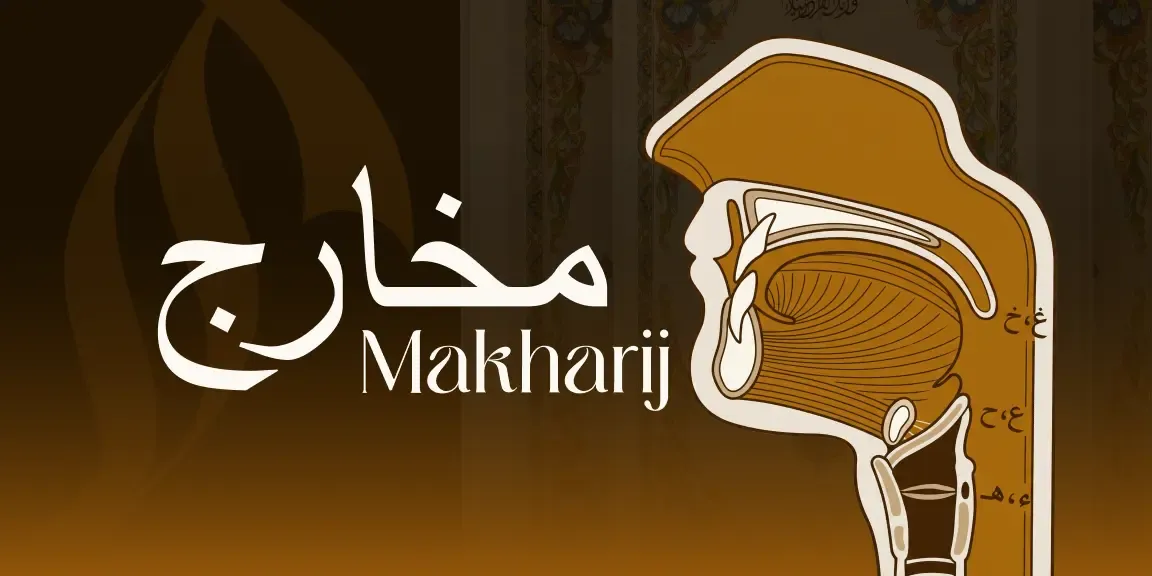
You may recognize every Arabic letter yet still hear two different letters coming out almost the same. Repeating a word does not always solve that problem. The tongue, lips or throat may be forming the wrong sound each time.
Makharij explains where Arabic sounds are produced. This guide maps the main articulation areas, compares easily confused letters and shows how focused practice can improve Quran reading. It also explains why a written chart needs to be paired with listening and individual correction.
What Are Makharij in Tajweed?
Makharij are the articulation places used to produce Arabic letter sounds. The singular is Makhraj, and Makharij al-Huruf means the articulation places of the letters.
These places include the throat, tongue and lips, along with the open mouth-and-throat cavity and the nasal passage used for Ghunnah.
A widely taught classification associated with Ibn al-Jazari uses 17 specific articulation points within five general areas. Other traditional classifications group the points differently, so a different count does not automatically indicate an error.
Makharij and Sifaat Are Different
Makharij describes where a sound is formed. Sifaat describes its characteristics, such as airflow, strength and heaviness.
Letters can share an articulation area while differing in their characteristics. That is why locating the tongue alone does not settle every pronunciation question.
Both matter when distinguishing ت from ط, or س from ص.
The Five Makharij Areas and Their Letters
Makharij is not a vowel mark or a symbol above a letter. It is a description of how the letter’s sound is made.
General area | Arabic term | Specific points | Main sounds or letters |
Open mouth-and-throat cavity | Al-Jawf | 1 | Long-vowel Alif, Waw and Yaa in their Madd roles |
Throat | Al-Halq | 3 | ء ه ع ح غ خ |
Tongue | Al-Lisan | 10 | Eighteen consonants, including consonantal Yaa |
Lips | Ash-Shafatan | 2 | ف ب م and consonantal Waw |
Nasal passage | Al-Khayshum | 1 | Ghunnah associated with Noon and Meem |
Ghunnah is a nasal sound, not an additional alphabet letter. Noon and Meem also have their own oral articulation.
A Chart of the 17 Articulation Points
The descriptions below are orientation cues. Small differences in contact and airflow need a teacher’s demonstration.
Point | Area or contact | Letter or sound |
1 | Open cavity | Madd ā, ū, ī |
2 | Deepest throat region | ء ه |
3 | Middle throat region | ع ح |
4 | Throat region nearest the mouth | غ خ |
5 | Back of tongue against corresponding palate | ق |
6 | Slightly forward of Qaf’s contact | ك |
7 | Middle tongue and corresponding palate | ج ش ي, excluding Madd Yaa |
8 | Tongue edge against upper molars | ض |
9 | Front tongue edges and tip against upper gum area | ل |
10 | Tongue tip against upper gum area near Laam’s point | ن |
11 | Tongue tip and adjacent upper surface near Noon’s point | ر |
12 | Tongue tip against upper front tooth-root area | ط د ت |
13 | Tongue tip near lower front teeth, airflow through the front gap | ص س ز |
14 | Tongue tip against upper front tooth edges | ظ ذ ث |
15 | Inner lower lip against upper front tooth edges | ف |
16 | Two lips | ب م و, excluding Madd Waw |
17 | Nasal passage | Ghunnah |
The chart groups shared points. It does not mean every letter in a row sounds the same.
What Should Correct Articulation Sound Like?
Correct articulation preserves each letter’s identity. Qaf should remain distinct from Kaf, and Haa ح should remain distinct from Haa ه.
A familiar English spelling cannot show all of these differences. Transliteration may use “h” for more than one Arabic letter, while the Arabic requires different sounds.
Throat Sounds Need Listening
The six throat letters are ء، ه، ع، ح، غ، خ. A beginner should hear each one with a short vowel before trying to reproduce it.
Avoid treating every unfamiliar throat letter as a cough or making it louder to force a distinction. Aim for a clear sound with comfortable effort.
Long Vowels Have a Different Role
Alif after Fatha, sakin Waw after Damma, and sakin Yaa after Kasra function as long vowels in the appropriate conditions.
Their classification under Al-Jawf differs from consonantal Waw and Yaa, which involve the lips and tongue respectively. Compare بُو — bū with وَ — wa, or بِي — bī with يَ — ya.
Ghunnah Is Not Added to Every Letter
Ghunnah belongs to specific recitation contexts associated with Noon and Meem. It is not a general method for making Arabic pronunciation sound more “Quranic.”
IACAD’s Tuhfat Al-Atfal course description treats Noon Sakinah, Tanween, Meem Sakinah and Madd as topics requiring both explanation and practice. Keep these rules connected to the letters and contexts where they apply.
How Do You Apply Makharij While Reading?
Start by identifying the letter, then read it with its actual vowel or Sukoon. Preserve its articulation as you join it to neighboring sounds.
Change the Vowel Without Losing the Letter
Practice قَ، قِ، قُ with a teacher. The vowels change, but Qaf should not turn into Kaf.
Repeat the same process with a second consonant. This checks whether you know the letter’s sound beyond one memorized syllable.
Use Sukoon to Examine the Articulation
A traditional exercise places a sakin consonant after a vowelled Hamza, as in أَفْ or أَمْ. It helps focus attention on where the sound is formed.
The teacher still needs to account for the letter’s characteristics. For example, a sakin Qalqalah letter has its appropriate release. Do not turn this exercise into a rule that every consonant must be cut off identically.
Keep Heavy and Light Sounds Distinct
The seven letters associated with Isti‘la are خ ص ض غ ط ق ظ. Their heavy quality is not produced simply by speaking more loudly.
Other letters can have context-specific treatment, including Raa and the Laam in the name Allah. Alif also follows the quality of the preceding sound.
Learn the ordinary articulation first, then apply the relevant characteristics and context.
Makharij Practice for Noorani Qaida Learners
Choose a small set of contrasts and keep the vowel the same. That makes the consonant difference easier to hear.
Practice contrast | What to listen for |
هَ / حَ | Two distinct throat sounds |
أَ / عَ | Hamza and Ayn remain distinguishable |
كَ / قَ | Kaf and Qaf do not merge |
تَ / طَ | Light Taa and heavy Taa remain distinct |
سَ / صَ | Seen and Saad retain their different qualities |
ذَ / زَ | Dhaal does not become Zay |
ثَ / سَ | Thaa does not become Seen |
فَ / بَ | Lip-to-teeth contact differs from two-lip contact |
These are practice contrasts, not a ranking of how often students make mistakes.
A Short Listening-and-Reading Exercise
- Listen while the teacher reads one of two letters.
- Point to the letter you heard.
- Repeat it with the same vowel.
- Change the vowel while retaining the consonant.
- Read a word containing that letter.
- Ask for one specific correction before repeating.
Listening recognition and spoken production are separate skills. A learner may identify the correct letter by ear but still need help producing it.
For broader Arabic literacy support, the Dubai Government Media Office describes Madrasa’s Arabic lessons as covering reading, speech, writing and comprehension. Those activities can supplement word recognition; individual recitation feedback checks whether the actual letter sound is correct.
Pronunciation Mistakes to Check With English-Speaking Learners

The comparisons below are useful diagnostic exercises. They are not Al Asr student statistics or claims that all English speakers have the same difficulties.
Producing Qaf as Kaf
Ask the learner to alternate كَ and قَ. If both sound alike, return to the difference in tongue contact and sound quality.
Practice at a comfortable volume. Making the same Kaf louder does not produce Qaf.
Treating Haa ح as Haa ه
Give both letters the same vowel so the comparison stays clear. Ask the teacher to model the different throat positions and listen to the learner’s attempt.
Avoid relying on an English “h” description for both letters.
Replacing Ayn With Hamza or a Vowel
A learner may omit ع or substitute a glottal onset. Compare أَ and عَ, then practice Ayn in a short word.
Its absence from ordinary English pronunciation makes a spoken model particularly useful. Do not try to represent it only by an apostrophe.
Replacing Thaa or Dhaal
Depending on the learner’s existing sound patterns, ث or ذ may drift toward س, ز, ت or د.
Check the tongue’s relation to the upper front teeth. English “th” can be a useful initial comparison for some accents, but it should not replace the teacher’s Arabic model.
Making Heavy Letters Merely Louder
Compare سَ / صَ and تَ / طَ at the same volume. The distinction should come from the appropriate articulation and characteristics.
Treating Daad as an Ordinary Daal
Daad ض uses the tongue edge against the upper molar region. Calling it only a “heavy d” can hide this important difference.
This is a suitable letter for focused live correction. A short written cue cannot show whether the learner is using the intended contact.
Over-Rolling Raa
A learner may add several repeated tongue movements while trying to make ر clear.
Ask for a controlled model and practice it within a short word. Greater repetition is not automatically greater accuracy.
Adding a Vowel After a Sakin Letter
Sometimes the letter’s place is correct, but an added a, i or u changes the syllable.
Check articulation and vowel use separately. A learner should know which part needs correction.
Where Are Makharij Taught in Noorani Qaida?
Articulation belongs in the first letter lessons and continues throughout the course. It should not be postponed until the student reaches a chapter with “Makharij” in its title.
Al Asr Quran Academy’s published outline lists Letter Articulation Points (Makharij) as its seventh topic. That is the course’s listed sequence, not a universal page or lesson number for every Qaida edition.
The practical progression is to recognize a letter, hear its sound, produce it with vowels, and keep it clear in connected words. Sukoon, Shaddah and long vowels add new conditions for applying the same foundation.
A student who reads quickly but merges distinct consonants may need targeted correction before longer passages.
How Does a Tutor Assess Makharij?
A useful assessment identifies the exact substitution or articulation problem instead of giving a broad instruction to “read better.”
The teacher can record:
Assessment item | What to note |
Target letter | The intended Arabic consonant |
Heard sound | The substitution or unclear feature |
Reading condition | Isolated, vowelled, sakin, doubled or in a phrase |
Correction | The specific contact or sound adjustment |
Retest | Whether the correction holds in a new example |
A camera can help with visible lip and tongue movements. It cannot show every throat or internal tongue position, so careful listening remains essential.
For online learning, a free trial class at Al Asr Quran Academy can establish the learner’s starting point. Bring a short passage and mention any letters that remain difficult to distinguish.
Frequently asked questions
How Many Makharij Are There?
A widely taught classification uses 17 specific points within five general areas. Traditional scholars have also used other groupings.
What Are the Five Main Areas?
Al-Jawf, Al-Halq, Al-Lisan, Ash-Shafatan and Al-Khayshum: the open cavity, throat, tongue, lips and nasal passage.
Does Every Letter Have a Completely Separate Point?
No. Some letters share an articulation point or region and differ through their characteristics. Makharij and Sifaat work together.
Are All Arabic Letters Produced in the Mouth?
No. The classification also includes throat regions, the open mouth-and-throat cavity and the nasal passage for Ghunnah.
Can Adults Improve Their Makharij?
Yes. Start with specific sound contrasts and individual feedback. Progress depends on the learner’s starting point and practice; there is no single completion time for everyone.
Is Memorizing the Chart Enough?
No. A chart describes the locations, but pronunciation requires hearing, producing and checking the sounds. Knowing a location’s name does not prove correct articulation.
Do Noon and Meem Come Only From the Nose?
No. Noon has an oral articulation involving the tongue, and Meem involves the lips. Their Ghunnah uses the nasal passage.
Should I Practice Many Difficult Letters at Once?
Start with a small set that a teacher has checked. Apply the correction to different vowels and words before expanding the set.
Ready to start learning the Quran?
Book a free trial class with a certified tutor — no credit card, no commitment.
Book Your Free Trial