
Noorani Qaida in English
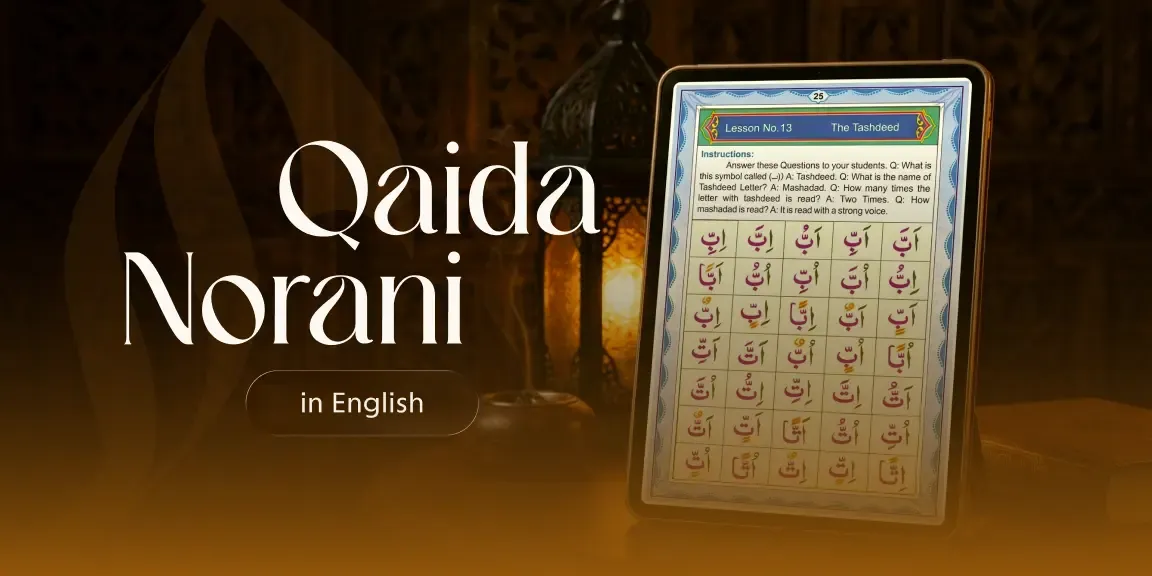
Arabic letters can feel unfamiliar even when you have heard Quran recitation for years. English explanations make those first lessons easier to follow. But reading a pronunciation guide in English is different from recognising and sounding out the Arabic yourself.
Noorani Qaida in English can help beginners understand instructions and start practising. This guide explains what an English edition contains, how transliteration works, where it becomes limiting, and how a teacher can support the move towards independent Arabic reading.
What Is Noorani Qaida in English?
Noorani Qaida in English is an Arabic reading primer supported by English instructions, explanations or pronunciation guides. The letters and exercises being studied remain Arabic.
The phrase can describe several different resources. Before choosing a book or course, check what “English” actually refers to.
Type of English support | What it provides | What to check |
English instructions | Explanations of how to complete an exercise | Are the instructions clear for the learner’s age? |
English explanations | Descriptions of letters, vowel marks and reading concepts | Do explanations connect directly to the Arabic examples? |
Transliteration | Arabic sounds represented with Roman letters and sometimes additional symbols | Is it presented as a temporary pronunciation aid? |
English-speaking tuition | A teacher explains the Arabic lesson in English | Does the student receive individual pronunciation correction? |
An English-speaking teacher does not necessarily use a transliterated edition. They may teach directly from Arabic pages while explaining each exercise in English.
For parents, this distinction is useful. A child may need instructions in English without needing English letters printed beneath every Arabic example.
How Does Noorani Qaida Transliteration Work?

Transliteration represents Arabic letters or sounds using another writing system. In an English-supported Qaida, it usually uses Roman letters to suggest pronunciation.
For example, the Arabic combinations بَ, بِ and بُ may appear beside the guides ba, bi and bu. These can help a beginner connect a familiar written cue with an unfamiliar Arabic symbol.
However, the Roman spelling is only a guide. The learner still needs to hear the sound and connect it to the Arabic text.
Transliteration also differs from translation:
- Transliteration suggests how something sounds.
- Translation explains what something means.
A Qaida exercise may practise letters and vowel combinations without forming a meaningful word. Its purpose is reading practice, so an English pronunciation guide should not be mistaken for an English meaning.
Why Do Different Books Use Different Spellings?
Romanisation systems vary. One resource may use paired letters, while another uses dots, apostrophes or specialist symbols to distinguish Arabic sounds.
For instance, ح may be represented as ḥ in a detailed system, while a simplified resource may use h. A beginner who does not understand that distinction may read different Arabic letters as though they were the same.
Use a consistent resource and ask the teacher to explain its notation. Changing between several systems can introduce unnecessary confusion.
What Are the Limits of English Transliteration?
English transliteration cannot, by itself, teach all the sound distinctions required for accurate Arabic reading.
It may help a learner begin an exercise, but it does not hear their attempt or establish whether their pronunciation matches the intended sound.
English Spelling Does Not Produce One Predictable Sound
English letters are pronounced differently across words and accents. A learner may apply familiar English habits to an Arabic pronunciation guide without realising it.
Even when two learners read the same Roman spelling, they may produce different sounds. A clear spoken example helps reduce this uncertainty.
Some Arabic Sounds Need More Than an English Approximation
Arabic letters such as ع and ح need careful listening and guided practice. An English spelling alone does not explain exactly how to produce them.
Specialist transliteration can distinguish these letters on paper. That is useful notation, but recognising the symbol and producing the sound are separate skills.
Transliteration Can Divert Attention From Arabic
When a familiar English guide sits beneath unfamiliar Arabic, the learner may naturally read the English first.
This can create misleading progress. The student finishes the line but struggles when the pronunciation guide is covered. They may have followed the Roman text without recognising the Arabic letters and marks.
An occasional check is simple: cover the transliteration and ask the learner to read a few examples independently. Use the result to decide what needs more practice.
Pronunciation Still Needs Feedback
A written guide cannot tell whether a learner has overlooked a mark, confused two sounds or changed the intended vowel length.
If you are deciding how to combine written material with audio and individual instruction, compare the options in our guide to how to learn Noorani Qaida. The choice should include a practical way to check spoken reading.
Why Is Reading Arabic Script the Goal?
The goal of Noorani Qaida is to recognise Arabic letters and marks and read their combinations without depending on Roman spellings.
English explanations can remain useful throughout the process. What gradually changes is the learner’s reliance on transliteration.
Arabic script practice helps learners connect:
- A letter’s visible form with its identity.
- Its dots and shape with similar-looking letters.
- Attached marks with the required reading.
- Joined forms with letters already recognised individually.
- Written combinations with sounds they can produce independently.
A learner does not need conversational Arabic fluency before starting. Reading the script, understanding vocabulary and speaking Arabic are related but distinct abilities.
How Can You Reduce Dependence on Transliteration?
Use the Arabic text as the centre of each exercise:
- Look closely at the Arabic letter or combination.
- Listen to a clear demonstration.
- Repeat while looking at the Arabic.
- Cover any Roman guide.
- Read the example independently.
- Return to uncertain examples for correction.
There is no need to remove every support at once. Reduce it as the learner demonstrates accurate recognition and reading.
Reading examples in a different order can also reveal whether the learner recognises them or remembers the sequence of the page.
How Does an English-Speaking Tutor Help?
An English-speaking tutor can explain the task in a familiar language while keeping the reading practice focused on Arabic.
For a beginner, an instruction such as “look at the mark above this letter” may be easier to follow than an unfamiliar technical explanation. The tutor can introduce Arabic terminology gradually and connect it to something visible or audible.
A useful lesson includes three different activities:
Lesson activity | Teacher’s role | Learner’s role |
Explanation | Describe the exercise clearly | Identify what needs attention |
Demonstration | Model the sound or combination | Listen and attempt it |
Assessment | Hear an independent reading and give a specific correction | Try again and apply the correction |
This matters particularly when the issue concerns articulation. Our guide to Arabic letter articulation points explains the role of Makharij in producing different sounds.
The UAE’s official Quran education service guide includes Tajweed learning and recitation improvement among its educational services. These are aspects of spoken reading that need attention alongside recognising the written text.
Can You Study at Al Asr Quran Academy in English?
Al Asr Quran Academy lists English, Urdu and Arabic instruction for its one-to-one Noorani Qaida classes. Beginners can therefore receive explanations in English while working on Arabic letters and pronunciation.
Before starting the Noorani Qaida online course, ask which edition the teacher uses and whether it includes transliteration. Share any materials you already practise with so the tutor can help you use them consistently.
Can English Speakers Use Noorani Qaida in Arabic?
Yes. English speakers can study from Arabic Noorani Qaida pages when the exercises are explained clearly and pronunciation is demonstrated.
An Arabic edition keeps attention on the script being studied. English support can come from the teacher rather than from Roman spellings beneath the exercises.
This approach may suit a learner who understands spoken instructions in English but is ready to practise recognising Arabic directly. Someone studying independently may need more help interpreting the tasks.
Before choosing an edition, check:
- Whether the print makes letters and marks easy to distinguish.
- Whether the teacher’s materials match your copy.
- Whether any accompanying audio follows the same exercises.
- Whether the instructions suit the learner’s starting level.
- Whether the source is authorised to supply the material.
What About a Noorani Qaida English PDF?
A Noorani Qaida English PDF may offer instructions, transliteration or both. Check sample pages rather than assuming the title tells you everything.
Choose readable text and a legitimate source. Permission to download, print or share a particular edition should be checked with its publisher or rights holder.
A digital file can make the page easier to access, but it does not replace a pronunciation demonstration or an assessment of the learner’s reading.
Frequently asked questions
Is Noorani Qaida in English a Translation of the Quran?
No. It is a beginner Arabic reading resource with English support. Its main purpose is to practise letters, marks and reading combinations, rather than explain the meanings of Quranic verses.
Can I Learn Noorani Qaida if I Only Speak English?
Yes. An English-speaking teacher can explain the exercises while introducing Arabic letters and sounds. You do not need to speak Arabic fluently before beginning.
Should Children Use English Transliteration?
Transliteration can serve as a temporary aid, but children should also practise reading the Arabic without it. If a child always looks at the Roman spelling first, ask the teacher how to reduce that dependence.
Is an English Edition Better Than an Arabic Edition?
The better choice depends on the support available. English instructions can help a beginner understand the task. Arabic pages can work equally well when a teacher explains them in English. Clear print, suitable exercises and pronunciation feedback matter in either format.
When Should I Stop Using Transliteration?
Reduce it when you can recognise and read the relevant Arabic examples independently. Progress may differ between lessons. Ask a teacher to check unfamiliar combinations before assuming a memorised page shows independent reading.
Can Adults Begin With Noorani Qaida in English?
Yes. Adults can use English explanations to understand beginner exercises while developing Arabic script recognition. The lesson pace and amount of practice should reflect their starting level.
Does Finishing an English Qaida Mean I Can Read the Quran Fluently?
Finishing the pages does not automatically establish fluency. Readiness depends on whether you can recognise letters, apply the marks and read combinations accurately without prompts. A teacher can assess the next suitable stage of Quran reading practice.
Ready to start learning the Quran?
Book a free trial class with a certified tutor — no credit card, no commitment.
Book Your Free Trial